Guess who is back!? 🎉
So, the Google Agentic Architect Sprint 2026 is here, and I couldn't resist 🥶
If you remember my previous post about building multi-agent systems, I introduced ducktAIpe, my sandbox repair tutorial generator where a crew of specialized AI agents (Gatekeeper, Researcher, Judge, and Content Builder) work together to turn technical problems into step-by-step guides.
For the Sprint, I wanted to tackle one of the most critical topics in AI architecture today: Governance, Reliability, and Safety. Specifically, how do we introduce Interactive Human-in-the-Loop Approval Gates without breaking the flow of a distributed multi-agent system?
Here is a deep dive into how I built it for ducktAIpe-sprint using an "Escrow-style" state suspension model ⬇️
Autonomy vs. Control: The AI Dilemma ⚖️
Fully autonomous agents are cool in demos, but in production, they can be terrifying. If an agent has access to system commands or external APIs (via Model Context Protocol / MCP), you flat-out cannot let it run wild without guardrails.
But how do you pause a running agent to ask a human, "Hey, is this fact-check correct?" or "Should I execute this tool?" without keeping HTTP connections open forever?
Human-in-the-Loop (HITL) Gate
A design pattern where an agent halts execution at a critical decision boundary, persists its current state, and waits for a human user to inspect findings and signal approval before resuming.
Instead of keeping a long-lived, brittle socket connection open while a user is away from their keyboard, we can design an Escrow Architecture.
The Escrow Design Pattern 📦
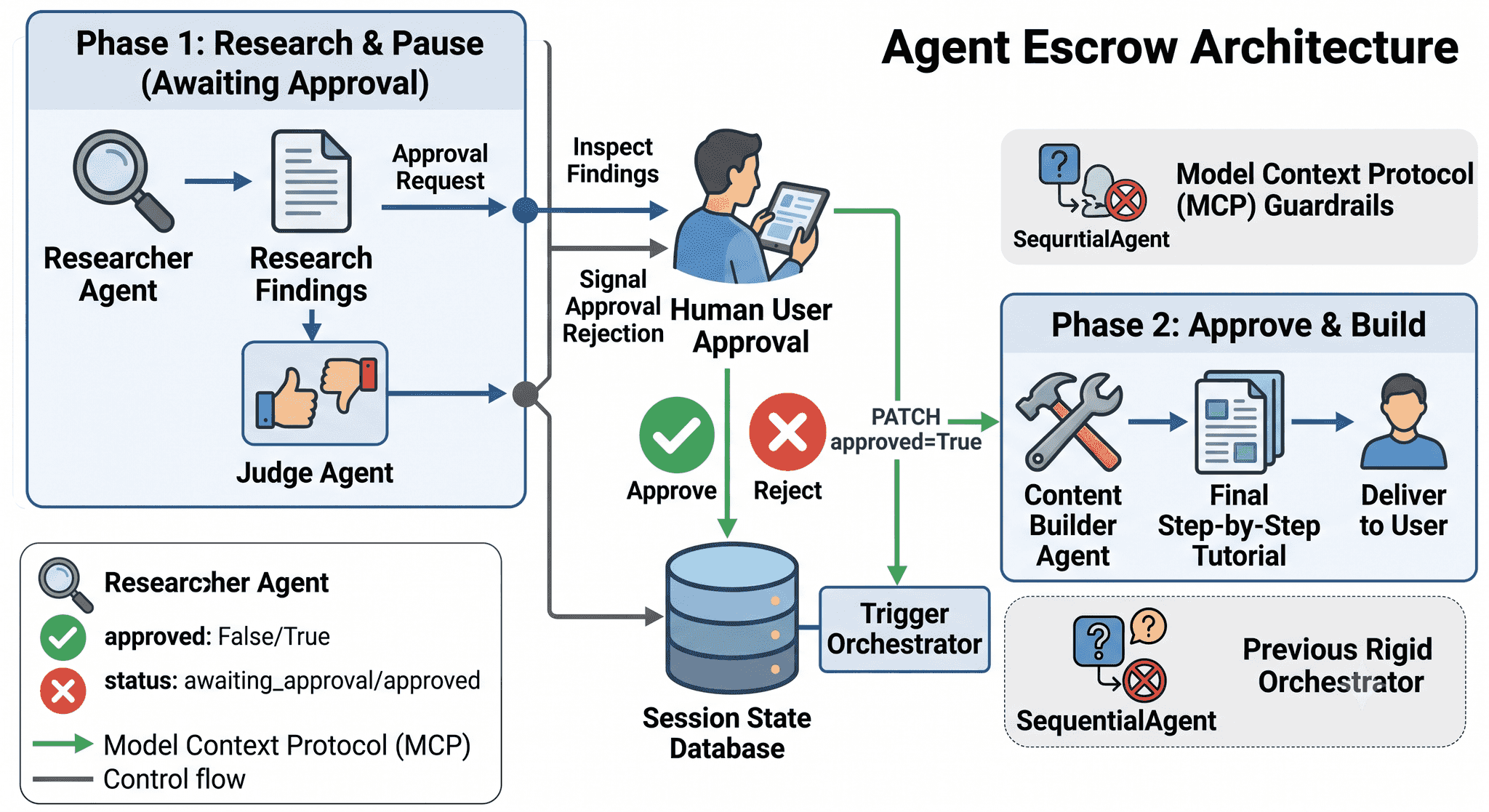
The concept is simple. We split the execution into two distinct phases governed by the user's session state:
- Phase 1 (Research & Pause): The Gatekeeper validates the prompt, the Researcher searches the web, and the Judge reviews the findings. If it passes, the orchestrator updates the session state to
awaiting_approvaland stops running. - Phase 2 (Approve & Build): The frontend displays the research findings. If the user clicks Approve, we make a
PATCHrequest to the session state settingapproved = True, and trigger the orchestrator again. The orchestrator loads the state, sees it's approved, skips the research phase entirely, and jumps straight to the Content Builder!
This stateless approach is incredibly robust. Here's how it works under the hood.
Under the Hood: The Code 🔧
1. The State-Aware Orchestrator
In the original ducktAIpe codebase, I used a static SequentialAgent from the Google ADK. To support conditional branching (i.e. skipping steps on resume), I wrote a custom orchestrator class extending BaseAgent:
class RepairTutorialPipeline(BaseAgent):
    async def _run_async_impl(self, ctx: InvocationContext) -> AsyncGenerator[Event, None]:
        state = ctx.session.state

        # Phase 2: If session is already approved, run ONLY the Content Builder
        if state.get("approved") is True:
            logger.info(">>> HITL Approval Gate: APPROVED: Executing Content Builder")
            async for event in content_builder.run_async(ctx):
                yield event
            return

        # Phase 1: Run the Gatekeeper and Research Loop
        logger.info(">>> Running Gatekeeper...")
        async for event in gatekeeper.run_async(ctx): yield event
        async for event in gatekeeper_checker.run_async(ctx): yield event

        # ... (Topic Enrichment and Research Loop execution) ...
        async for event in research_loop.run_async(ctx): yield event

        # Check if Judge passed the research
        judge_feedback = state.get("judge_feedback")
        if is_pass(judge_feedback):
            # Save state and pause!
            state["status"] = "awaiting_approval"
            yield Event(
                author=self.name,
                content={"parts": [{"text": "[STATUS: awaiting_approval] Research complete."}]}
            )
By switching to a custom BaseAgent subclass, we gain complete control over the execution path based on the persisted ctx.session.state.
2. Updating State without Running Agents
To update the session state when the user clicks "Approve", we call the ADK server's PATCH endpoint. Here is the FastAPI backend handler in main.py:
async def approve_session(agent_server_origin: str, agent_name: str, user_id: str, session_id: str) -> None:
    httpx_client = await get_client(agent_server_origin)
    headers = [("Content-Type", "application/json")]
    url = f"{agent_server_origin}/apps/{agent_name}/users/{user_id}/sessions/{session_id}"

    # We update the session state without executing any agent loops
    payload = {
        "state_delta": {
            "approved": True,
            "status": "approved"
        }
    }
    resp = await httpx_client.patch(url, headers=headers, json=payload)
    resp.raise_for_status()
Once the state is patched, the backend triggers /run_sse with a placeholder message. The Orchestrator wakes up, reads approved: True from the session database, and skips straight to the Content Builder.
The Frontend UX 🎨
On the frontend, when the stream receives the awaiting_approval payload, we hide the progress spinner, extract the research findings from the session object, and render a dedicated approval card:
} else if (data.type === 'awaiting_approval') {
    progressContainer.classList.add('hidden');
    approvalFindingsSummary.value = data.findings;
    approvalContainer.classList.remove('hidden'); // Show Approve / Reject buttons
}
If the user clicks Approve, we post to /api/approve_session, hide the card, resume the loading screen, and pipe the rest of the stream containing the final tutorial.
Conclusion 🏁
Implementing Human-in-the-Loop patterns doesn't have to mean maintaining stateful, fragile WebSocket connections or long-lived server threads. By leveraging the Session State Store of Google's ADK and using standard REST methods like PATCH, we built a robust, enterprise-grade escrow architecture that gives users complete control over their agentic workflows.
You can check out the full sprint codebase at my /ducktaipe-sprint redirect (or directly on GitHub).
What are your thoughts on agent escrow architectures? Let me know in the comments! 🦆